



By Marwa Mohsen
Baghdad,Iraq
With the expiration of the New START Treaty, the failure of the 2026 Nuclear Non-Proliferation Treaty Review Conference to reach consensus and rising tensions in the Middle East, a global media initiative could strengthen public accountability, challenge misinformation and help keep nuclear disarmament on the international agenda.
A World Facing Renewed Nuclear Risks
More than eight decades after the atomic bombings of Hiroshima and Nagasaki, nuclear weapons remain among the gravest threats to humanity. Despite decades of arms control negotiations and international commitments, nuclear deterrence continues to underpin the security policies of several states, while geopolitical rivalries and regional conflicts increase the risk of miscalculation.

The urgency is reflected in the Bulletin of the Atomic Scientists’ decision to set its Doomsday Clock at 85 seconds to midnight on 27 January 2026, the closest position in its history. The organisation cited deteriorating international cooperation, nuclear dangers and other global threats as reasons for its assessment. Although the clock is a symbolic measure rather than a scientific prediction, it highlights growing concerns about humanity’s capacity to manage existential risks.
Against this backdrop, “Voices for a Nuclear-Free Future” proposes a global media initiative to connect nuclear policy with public understanding, humanitarian concerns and diplomatic accountability. Its purpose would not be to replace negotiations or reduce complex security dilemmas to political slogans. Instead, it would create a platform where journalists, scientists, diplomats, academics, civil-society organisations and citizens could examine nuclear risks through evidence-based reporting and informed debate.
The Erosion of the Global Nuclear Order
The Treaty on the Non-Proliferation of Nuclear Weapons (NPT), which entered into force in 1970, remains the cornerstone of the international nuclear non-proliferation regime. It seeks to prevent the spread of nuclear weapons, advance disarmament and facilitate the peaceful use of nuclear energy.
However, the treaty’s central bargain remains contested. Non-nuclear-weapon states undertake not to acquire nuclear weapons, while the treaty establishes obligations concerning nuclear disarmament. Persistent dependence on nuclear arsenals has fuelled concerns about the fairness and effectiveness of this arrangement.
The challenge became more pronounced in 2026. The New START Treaty, the last remaining bilateral arms control agreement imposing central limits on US and Russian strategic nuclear arsenals, expired on 5 February without a successor agreement. Its expiration removed an important framework for legally binding limits and verification between the world’s two largest nuclear powers.
Meanwhile, the 11th NPT Review Conference, held at the United Nations in New York from 27 April to 22 May 2026, ended without consensus on a substantive outcome document. The failure demonstrated continuing divisions over non-proliferation, disarmament and regional security.
These developments underline the need for renewed diplomatic engagement and sustained public scrutiny.
The Middle East: A Persistent Nuclear Dilemma
The Middle East presents one of the most difficult challenges for nuclear arms control. Regional rivalries, unresolved conflicts, competing threat perceptions and unequal military capabilities have obstructed efforts to establish a common security framework.
Israel maintains a policy of nuclear ambiguity, neither officially confirming nor denying possession of nuclear weapons, and remains outside the NPT. Iran, meanwhile, maintains that its nuclear programme is peaceful, while its nuclear activities and the limitations on international verification have generated serious international concerns.
The 2015 Joint Comprehensive Plan of Action (JCPOA) sought to address the Iranian nuclear dispute through restrictions, monitoring and sanctions relief. The United States withdrew from the agreement in 2018, and subsequent developments progressively weakened the arrangement.
Military strikes against Iranian nuclear facilities in June 2025 further demonstrated the dangers of allowing nuclear disputes to become entangled with armed conflict. Such attacks can damage infrastructure, disrupt verification and increase uncertainty about nuclear intentions.
Responsible reporting must distinguish between civilian nuclear energy, uranium enrichment, weapons-development capabilities and an actual operational nuclear arsenal. These categories are related but not interchangeable. Imprecise language can exaggerate threats, intensify public anxiety and undermine opportunities for diplomacy.
The International Atomic Energy Agency (IAEA) therefore remains central to credible nuclear oversight through safeguards, inspections and technical verification.
Can the Middle East Become a Nuclear-Free Zone?
The proposal for a Middle East free of nuclear weapons and other weapons of mass destruction has a long diplomatic history.
In 1974, Iran and Egypt advanced a proposal for a regional nuclear-weapon-free zone, subsequently endorsed by United Nations General Assembly Resolution 3263. The 1995 NPT Review and Extension Conference adopted a resolution calling for the establishment of a Middle East zone free of weapons of mass destruction.
Despite decades of international discussion, the objective remains unrealised. Governments disagree over participation, verification, conventional military imbalances and whether progress should depend on resolving wider regional conflicts.
A credible agreement would require inclusive negotiations, reciprocal commitments, effective verification and consideration of the security concerns of all participating states. It would also require political willingness to address existing asymmetries rather than treating them as permanent features of regional security.
The objective is ambitious, but sustained diplomacy and incremental confidence-building measures could help create conditions for progress.
Beyond Deterrence: The Humanitarian Cost

Supporters of nuclear deterrence argue that the threat of retaliation discourages major wars. Yet deterrence depends on complex command systems, reliable communications and rational decision-making during crises.
Human error, technical malfunction, misinterpretation and escalation can undermine these assumptions. The potential consequences of nuclear use extend far beyond military targets, encompassing mass casualties, radiation exposure, infrastructure destruction, environmental damage and long-term public health consequences.
The Treaty on the Prohibition of Nuclear Weapons, which entered into force on 22 January 2021, represents an important legal initiative grounded in the humanitarian consequences of nuclear weapons. It prohibits activities including the development, possession, use and threat of use for states parties. However, nuclear-armed states have not joined the treaty, limiting its immediate reach over existing arsenals.
Survivors of Hiroshima and Nagasaki, communities affected by nuclear testing, medical professionals and humanitarian organisations provide essential perspectives that strategic discussions can overlook.
Their testimony should complement, rather than replace, rigorous analysis of military doctrines, verification arrangements and national security concerns.
Journalism as an Instrument of Nuclear Risk Reduction
Nuclear policy is frequently discussed through official statements, military assessments and diplomatic negotiations. Yet citizens whose lives could be affected by nuclear conflict often have limited access to clear explanations of these decisions.
Media organisations can help bridge this gap. Investigative journalism, expert interviews, documentary reporting and multilingual educational resources can explain complex developments without sensationalism.
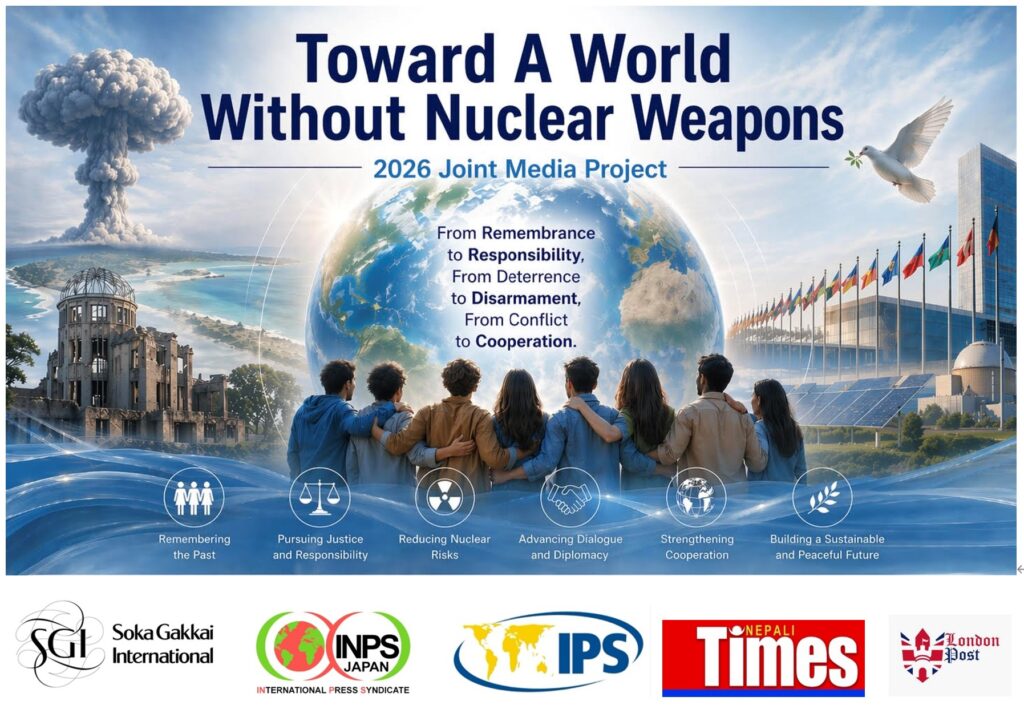
A global initiative such as Voices for a Nuclear-Free Future could establish a network connecting international news organisations, universities, research institutes and civil-society groups. Its work could include monitoring arms control commitments, explaining IAEA safeguards, examining nuclear doctrines and documenting the humanitarian consequences of nuclear weapons.
Editorial independence and factual accuracy would be essential. Journalists should distinguish verified evidence from official allegations, disclose uncertainty and consult qualified specialists. Arab, Iranian, Israeli and other regional perspectives should be represented alongside international analysis.
The initiative should also give younger journalists and researchers opportunities to contribute, ensuring that nuclear policy does not remain the exclusive preserve of governments and security establishments.
Source: INPS Japan
From Public Awareness to Political Action
Media cannot negotiate treaties or dismantle nuclear warheads. Its influence is indirect, but it can shape the political environment in which governments make security decisions.
A better-informed public can demand greater transparency, stronger verification, renewed arms control negotiations and effective crisis-communication mechanisms. Journalism can also examine practical measures, including confidence-building agreements, nuclear safety cooperation and renewed efforts to establish a Middle East zone free of weapons of mass destruction.
Progress will require compromises that recognise genuine security concerns without accepting permanent nuclear dependence as inevitable.
A nuclear-free world cannot be achieved through moral conviction alone. It requires political leadership, verifiable agreements, reciprocal commitments and sustained international cooperation.
Yet diplomacy operates within a wider public environment. Where misinformation dominates and nuclear threats become normalised, opportunities for cooperation can diminish. Where evidence, accountability and diverse perspectives are encouraged, the political space for restraint can expand.
“Voices for a Nuclear-Free Future” should therefore be understood not simply as a media campaign, but as a sustained international effort to connect strategic decisions with their human consequences.
The path towards nuclear disarmament remains uncertain. But keeping the debate informed, inclusive and grounded in evidence is an essential step towards a safer international order.
This article is brought to you by London Post in collaboration with INPS Japan and Soka Gakkai International, in consultative status with the UN’s Economic and Social Council (ECOSOC).

INPS Japan