

By Ahmed Fathi
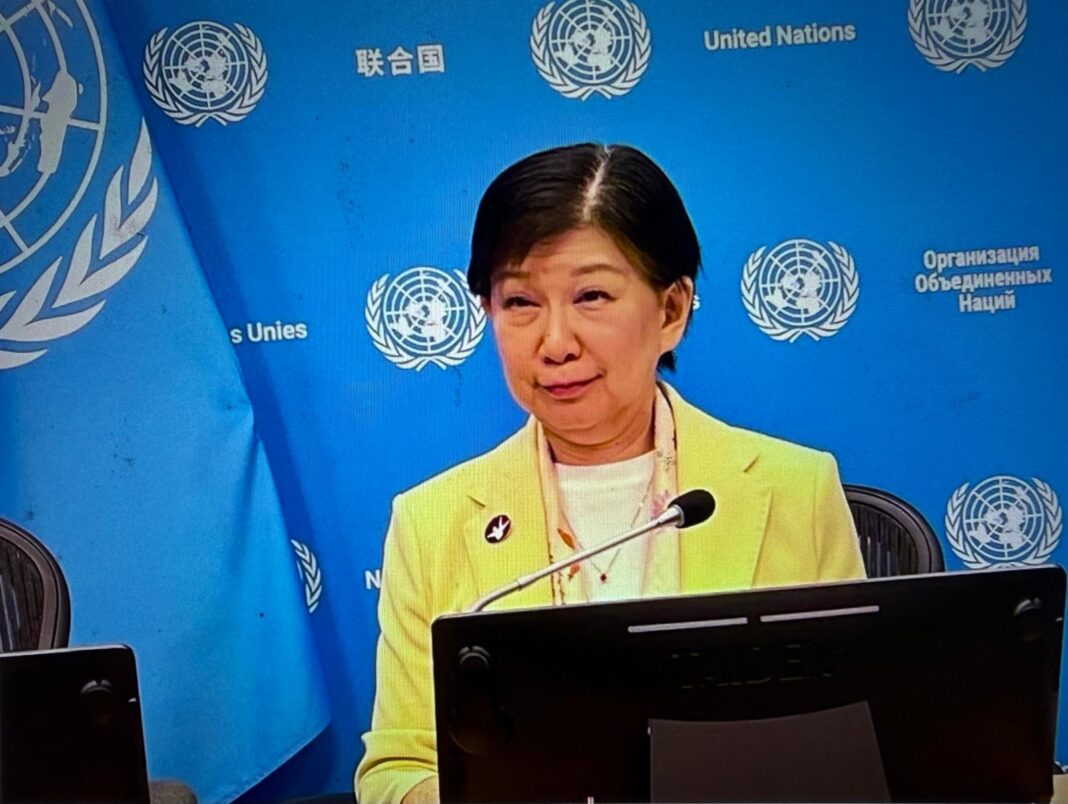
UNHQ, New York (INPS Japan/ATN) – The world’s central nuclear bargain is heading back to the diplomatic table under pressure, and this time, simply keeping the lights on may not be enough, as U.N. Disarmament chief Izumi Nakamitsu urged countries to take the upcoming 11th Review Conference of the Parties to the Treaty on the Non-Proliferation of Nuclear Weapons seriously and carefully, warning that the NPT is crucial for global security as nuclear dangers are becoming more real.
The conference is scheduled to take place from April 27 to May 22 at United Nations headquarters in New York, bringing together states parties to review a treaty that has shaped the nuclear order for more than five decades. Nakamitsu, the U.N. Under-Secretary-General and High Representative for Disarmament Affairs, described the NPT as “the cornerstone of the international disarmament and non-proliferation regime” and “a crucial pillar of international peace and security.”
That language is familiar in U.N. disarmament circles. The problem is that the world around the treaty is no longer familiar.
The previous NPT Review Conference failed to adopt a consensus outcome document. Since then, the global security environment has hardened further. Wars are reshaping threat perceptions, nuclear rhetoric is re-emerging in public debate, arms-control frameworks are weakening, and nuclear-armed states are continuing to modernize their arsenals, while many non-nuclear states are questioning whether the disarmament aspect of the bargain is being honored.
Nakamitsu called on states parties to “take their collective responsibility very seriously” and to “engage in good faith,” stressing that the treaty provides “irreplaceable benefits” to both nuclear-armed and non-nuclear-armed states.
Her message was not only procedural. It was political.
The NPT rests on three pillars: preventing the spread of nuclear weapons, advancing nuclear disarmament, and preserving the right to peaceful nuclear energy under safeguards. That balance has always required trust. Non-nuclear states accept limits on what they can acquire. Nuclear-weapon states commit to pursue disarmament. All parties are supposed to share in the peaceful uses of nuclear technology.
But that bargain is now under visible strain.
For many non-nuclear states, the frustration is straightforward: they are asked to comply with strict non-proliferation obligations while nuclear-weapon states defend modernization programs and move cautiously, if at all, on disarmament. For nuclear-armed states and their allies, the counterargument is that today’s security environment makes rapid disarmament unrealistic and places greater emphasis on deterrence, stability, and risk reduction.
Nakamitsu acknowledged that nuclear-weapon states have a special responsibility, but she also said the security concerns of non-nuclear states cannot be treated as secondary. “When it comes to nuclear weapons, it’s not just the security of nuclear-weapon states but the security of the entire global community,” she said.
This issue fundamentally centers the 2026 conference.
The issue is no longer whether diplomats can produce another carefully balanced document. The real test is whether the NPT can still command political confidence among states that see nuclear weapons returning to the center of global power politics.
The Middle East will be one of the most sensitive arenas in that debate. Tensions surrounding Iran’s nuclear program remain unresolved, and the long-stalled goal of establishing a Middle East zone free of nuclear weapons and other weapons of mass destruction continues to sit at the intersection of regional security, non-proliferation, and accusations of double standards.
Nakamitsu said Iran still intends to participate in the review conference, noting that a senior member of the Iranian government remained listed as part of the delegation. “We have not heard from the government of Iran otherwise,” she said, adding that the weekend would clarify who ultimately represents Tehran in New York.
Iran’s presence will matter. So will the way other states frame the broader Middle East file. For years, Arab states and members of the Non-Aligned Movement have pressed for progress on a regional zone free of nuclear weapons and other weapons of mass destruction. The issue has repeatedly complicated NPT diplomacy, not only because of Iran, but also because of Israel’s undeclared nuclear status and the wider security imbalance in the region.
The 2026 review therefore opens with a credibility problem on several fronts at once. The treaty is still widely defended as indispensable. However, the political conditions that once supported it are now deteriorating.
In her briefing, Nakamitsu warned against allowing the NPT to be “hollowed out,” saying the treaty’s authority depends on preserving both its obligations and its political credibility. She said states would need to show flexibility and seriousness to avoid another failed outcome, as the review opens against a backdrop of war in Ukraine, tensions around Iran’s nuclear program, and uncertainty over the future of New START, the last major U.S.-Russia nuclear arms-control framework.
That is the shadow hanging over Monday’s opening.
For the United Nations, the NPT Review Conference is not just another diplomatic gathering. It is a test of whether states can still defend a shared nuclear framework in an era when mistrust has become the default setting of international politics.
For the nuclear-weapon states, the question is whether they can show that disarmament commitments remain credible. For non-nuclear states, the question is whether the bargain they accepted still offers fairness, security, and restraint. For the Middle East, the question is whether old promises can survive new crises.
The NPT is not collapsing. But it is being tested.
And in New York next week, the measure of success will not be whether delegates avoid embarrassment. The question is whether they can prove that the treaty still has enough political weight to reduce nuclear danger in a world that is again learning to speak the language of nuclear risk.
This article is brought to you with permission from American Television Network.
Original URL:https://www.amerinews.tv/posts/npt-credibility-on-the-line-as-nakamitsu-warns-nuclear-treaty-faces-critical-test
INPS Japan