




By Katsuhiro Asagiri
TOKYO / ASTANA / VIENNA (INPS Japan) — Thirty-five years after Kazakhstan shut down the former Soviet Union’s Semipalatinsk nuclear test site, the country and the Comprehensive Nuclear-Test-Ban Treaty Organization (CTBTO) have renewed their call for international action to bring nuclear testing to a permanent end.|JAPANESE|GERMAN|

The appeal comes at a time when nuclear weapons are once again assuming a greater role in national security strategies and the global nuclear disarmament and non-proliferation regime is facing mounting pressure.
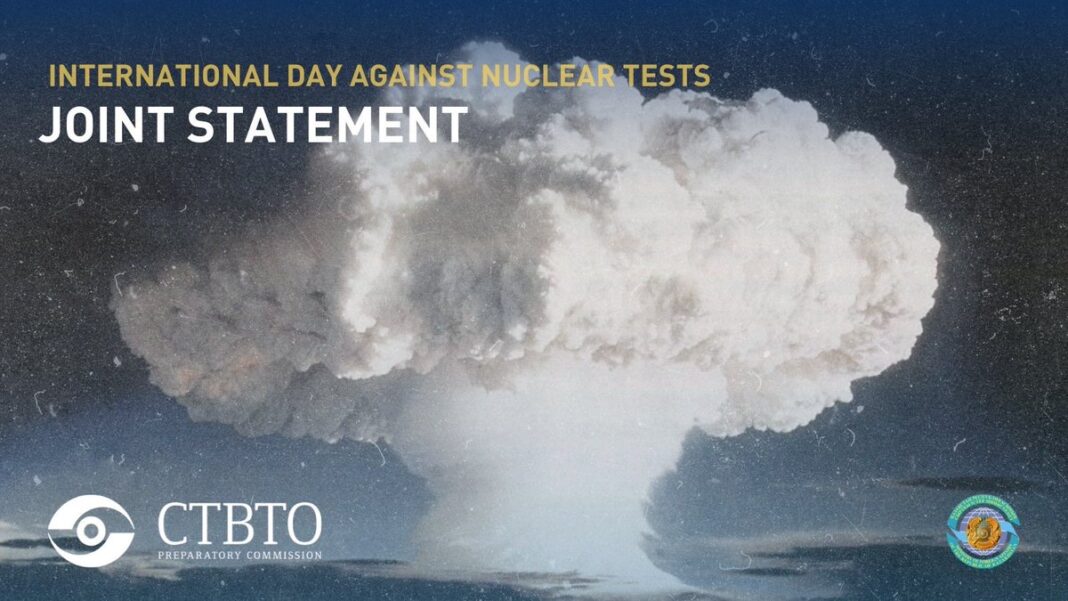
In a joint statement issued on Aug. 29 to mark the International Day against Nuclear Tests, Kazakhstan’s Foreign Minister Yermek Kosherbayev and CTBTO Executive Secretary Robert Floyd reaffirmed their commitment to achieving a world free of nuclear tests and called for stronger efforts to bring the Comprehensive Nuclear-Test-Ban Treaty (CTBT) into force.
The statement underscored that 2026 marks several significant milestones for global nuclear disarmament and non-proliferation.
At the heart of them is the 35th anniversary of the closure of the Semipalatinsk nuclear test site.
More Than 450 Nuclear Tests — and a Legacy That Endures
At Semipalatinsk, in what is now northeastern Kazakhstan, the Soviet Union conducted more than 450 nuclear tests over four decades.
Across the vast steppe, remnants of testing facilities still stand, bearing witness to the human and environmental consequences of the nuclear age.
The joint statement described Semipalatinsk as a stark example of the “dangerous consequences, human trauma, and environmental damage” caused by nuclear testing.
On Aug. 29, 1991, shortly before the dissolution of the Soviet Union, Kazakhstan closed the Semipalatinsk nuclear test site.
The decision, the statement noted, did far more than close a single testing ground. It sent a “powerful political message” to the international community and played an important role in the broader global movement that ultimately led to the adoption of the CTBT.
Eighteen years later, in December 2009, the United Nations General Assembly, acting on an initiative by Kazakhstan, designated Aug. 29 as the International Day against Nuclear Tests.
CTBT Marks 30 Years
This year also marks a major anniversary for the CTBT itself.
The treaty was adopted by the UN General Assembly on Sept. 10, 1996, and opened for signature on Sept. 24. Seventy-one countries signed it on the first day.
According to the joint statement, the treaty has now received 188 signatures and 179 ratifications. Kosherbayev and Floyd welcomed the recent signature and ratification by the Kingdom of Tonga, noting that every additional commitment strengthens the international norm against nuclear testing.
Yet three decades after its adoption, the CTBT has still not entered into force.
That is because its entry into force requires ratification by all states specifically listed in Annex 2 of the treaty.
Kosherbayev and Floyd therefore urged countries that have yet to sign and/or ratify the treaty to do so without delay. In particular, they called on the remaining Annex 2 states whose ratification is required for the CTBT to enter into force to demonstrate their commitment to nuclear non-proliferation and disarmament.
They also called on all states to uphold and reaffirm their existing moratoria on nuclear testing.
Central Asia’s Choice to Remain Free of Nuclear Weapons
Another anniversary in 2026 carries particular significance for Kazakhstan.
Sept. 8 marks 20 years since the signing of the Treaty of Semipalatinsk, which established the Central Asian Nuclear-Weapon-Free Zone.
The joint statement described the agreement as a “historic achievement” and a testament to the region’s commitment to nuclear non-proliferation and disarmament.
Semipalatinsk therefore embodies two sharply contrasting chapters of the nuclear age.
One is the history of hundreds of nuclear tests and their devastating consequences. The other is the decision to close the test site and pursue security without nuclear weapons.
A Global Network Watching for Nuclear Tests
The statement also highlighted progress in building the CTBT’s global verification regime.
Today, 308 facilities worldwide — 293 monitoring stations and 15 radionuclide laboratories — have been certified, bringing the International Monitoring System (IMS) to more than 90 percent completion.
The IMS uses seismic, radionuclide, hydroacoustic and infrasound technologies to detect evidence of nuclear explosions around the globe.
The statement described the system as a “unique global asset” that contributes not only to international peace and security but also provides important civilian and scientific benefits.
Kazakhstan itself plays a significant role in the verification system. Five IMS stations are operated by the country’s National Nuclear Center (NNC).
Kazakhstan has also contributed to the development of the CTBTO’s On-Site Inspection (OSI) capabilities. Four field experiments were conducted in the country, including at the Semipalatinsk nuclear test site, in 1999, 2002, 2005 and 2008.
The 1999 experiment was the first of its kind in CTBTO history, while the 2008 exercise was the largest ever conducted at the time.
The next major exercise, the On-Site Inspection Integrated Field Exercise 2026 (IFE26), is scheduled to take place in Namibia in October. It will be the first such integrated exercise hosted in Africa.
Protecting Hard-Won Gains
The joint statement described the CTBT as a key pillar of the international nuclear disarmament and non-proliferation regime, alongside the Treaty on the Non-Proliferation of Nuclear Weapons (NPT).
Kosherbayev and Floyd also invited states to participate in the high-level plenary meeting of the UN General Assembly commemorating the International Day against Nuclear Tests, scheduled for Aug. 31 at UN Headquarters in New York.
Beyond governments, the statement called on diplomats, academics, the media and non-governmental organizations to raise public awareness of the catastrophic dangers and risks associated with nuclear testing.
Its conclusion conveyed a sense of urgency about the challenges confronting the international community three decades after the CTBT was opened for signature.
The anniversary, the two officials said, should serve not merely as a reminder of what the international community has accomplished, but as a renewed call to action:
“To hold on to hard-fought gains. To renew momentum towards a world free of nuclear weapons. To bring the Comprehensive Nuclear-Test-Ban Treaty into force and to ensure a permanent and legally binding end to nuclear testing.”
Thirty-five years ago, the decision to close Semipalatinsk demonstrated that nuclear testing could be stopped through political will.
Today, with the CTBT still awaiting entry into force three decades after it was opened for signature, the lesson of Semipalatinsk is no longer simply a matter of history. It poses a question to the international community about the choices it is prepared to make now — and whether the political will that helped close one of the world’s largest nuclear testing grounds can finally be translated into a permanent, legally binding global ban on nuclear tests.

INPS Japan