




By Roman Yanushevsky
Jerusalem (INPS Japan)- Amid the escalating confrontation between Iran, the United States and Israel, many analysts now believe that Iran has entered a new political phase – one in which hardline security figures, military-linked technocrats and Revolutionary Guard commanders hold more real influence than at any time since the 1980s. |RUSSIAN|JAPANESE|

While Iran’s formal state structure remains intact, several Western and Israeli intelligence assessments describe the current leadership environment as effectively a wartime consolidation of power around the security establishment.
This shift matters because many of the figures now shaping Iranian strategic policy appear significantly less interested in compromise with the West than previous generations of Iranian negotiators.
The collapse of years of diplomacy, the reimposition of sanctions, sabotage operations against Iranian nuclear facilities and repeated threats of military action have strengthened the argument inside Tehran that only a nuclear deterrent can guarantee the survival of the Islamic Republic.
For decades, Iranian officials publicly insisted that their nuclear program was intended for civilian purposes – energy production, scientific research and medical isotopes. Yet Iran simultaneously expanded uranium enrichment far beyond levels needed for ordinary civilian nuclear power.
According to the International Atomic Energy Agency, Iran now possesses uranium enriched to near weapons-grade purity and enough fissile material that, if further enriched, could theoretically support multiple nuclear devices.
The Iranian perspective
The logic driving Tehran is not difficult to understand from the Iranian perspective. Iranian strategists often point to countries that possessed nuclear weapons and avoided foreign-led regime change.
North Korea is the example most frequently cited in regional discussions. Despite extreme international isolation and sanctions, Pyongyang’s nuclear arsenal effectively removed the possibility of a direct American military invasion.
By contrast, regimes that lacked nuclear deterrence – such as those in Iraq under Saddam Hussein or Libya under Muammar Gaddafi – were ultimately overthrown after abandoning or failing to complete weapons programs.
From Tehran’s viewpoint, these precedents send a clear message: nuclear capability may be the only reliable insurance policy against external intervention.
Iranian officials also argue that they face a uniquely hostile security environment. The country is surrounded by American military bases, rival Gulf monarchies and (apparently) nuclear-armed Israel. Iranian hardliners increasingly present nuclear capability not merely as a weapon, but as a symbol of strategic equality and national survival.
The American perspective
For the United States, however, preventing Iran from obtaining nuclear weapons has become one of the central pillars of Middle Eastern security policy.
Washington’s concerns are both immediate and long-term. American administrations of both parties have argued that a nuclear Iran could fundamentally destabilize the region, trigger a nuclear arms race and dramatically increase the risk of war involving Israel and U.S. allies.
American intelligence officials also worry about the possibility of “nuclear shielding.” In this scenario, Iran would use the protection of a nuclear deterrent to act more aggressively through regional proxy groups such as Hezbollah, militias in Iraq or the Houthis in Yemen, assuming that adversaries would hesitate to retaliate directly against a nuclear-capable state.
The regional perspective
Israel views the threat in even more existential terms. Israeli leaders across the political spectrum have repeatedly declared that they will not allow Iran to obtain nuclear weapons capability.
The reasons are partly strategic and partly historical. Iranian officials and Revolutionary Guard commanders have for years used rhetoric calling for the destruction of Israel, while simultaneously financing and arming anti-Israeli militant groups across the region.
For many Israelis, the combination of ideological hostility, ballistic missile development and nuclear capability represents an unacceptable risk – even if Iran never actually used a nuclear weapon (since it doesn’t possess it). Israeli defense planners argue that the mere existence of an Iranian bomb could severely restrict Israel’s freedom of action and create permanent strategic vulnerability.
The Gulf states are also deeply alarmed, even though several of them maintain cautious diplomatic relations with Tehran.
Countries such as Saudi Arabia and UAE fear that an Iranian nuclear umbrella could allow Tehran to dominate the Persian Gulf politically and militarily. These governments are particularly concerned about Iran’s missile forces, proxy networks and influence over Shiite movements throughout the region.
As a result, many analysts believe a nuclear Iran could trigger a regional proliferation cascade. Saudi Arabia has repeatedly hinted that it would pursue its own nuclear option if Iran crossed the threshold. Turkey and Egypt could eventually face similar pressure to reconsider their strategic posture.
Is there a threat?
Still, some experts argue that fears of an immediate Iranian nuclear apocalypse are sometimes exaggerated.
Even if Iran built a bomb, the leadership in Tehran is generally viewed by intelligence agencies as rational and survival-oriented rather than suicidal. Most nuclear states historically became more cautious – not less – after obtaining nuclear weapons, because the costs of direct war increased dramatically. Supporters of this view compare Iran to other hostile but deterrable nuclear powers.
Critics of this argument respond that Iran is different because of the complexity of the Middle East, the role of proxy warfare and the possibility of miscalculation. They also warn that the risk is not limited to deliberate nuclear attack. A regional crisis involving missiles, militias or naval incidents could spiral unpredictably once nuclear weapons are involved.
Technically, Iran appears closer to nuclear weapons capability than at any previous point in its history.
According to multiple assessments by the Institute for Science and International Security and the IAEA, Iran possesses enough highly enriched uranium that, if weaponized, could potentially produce material for several nuclear devices within months.
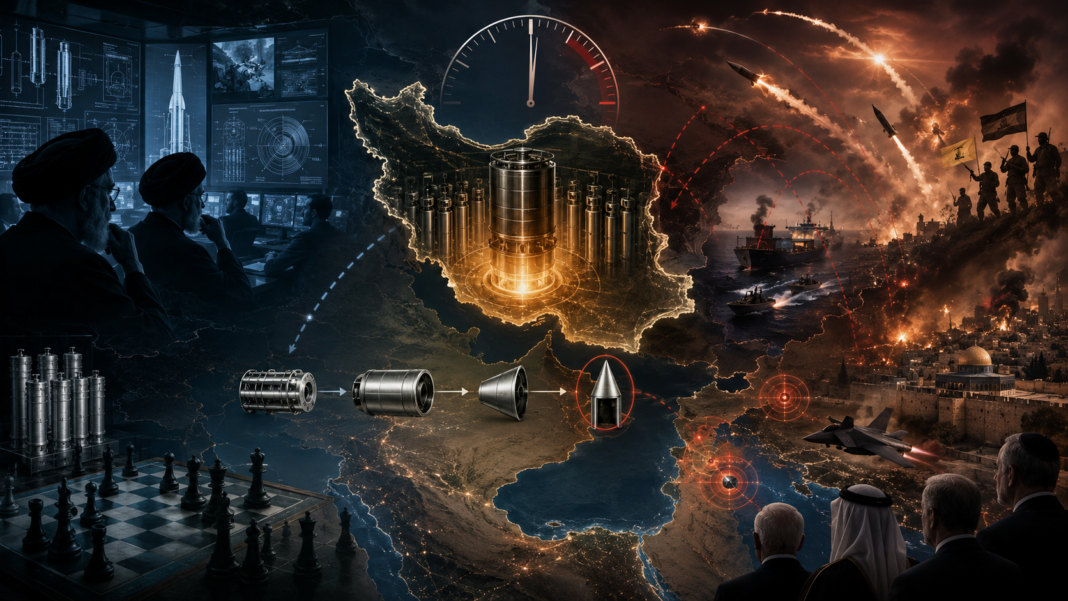
However, producing fissile material is only part of the challenge. Iran would still need to:
- build a functional warhead,
- miniaturize it,
- integrate it with a missile system,
- and conduct reliable testing or simulation.
Western intelligence agencies differ on how quickly this could happen. Some estimates suggest Iran could produce crude nuclear devices relatively rapidly if it made the political decision to do so. Building a reliable deployable arsenal, however, would likely take considerably longer.
How many bombs could Iran theoretically build? That depends on enrichment levels, weapon design efficiency and how much uranium Tehran chooses to retain as reserve stock. Some recent estimates suggest Iran’s current enriched uranium stockpile could eventually support material for roughly 5 to 10 simple nuclear devices if fully weaponized.
That does not mean Iran possesses bombs today. There is still no public evidence that Tehran has assembled an operational nuclear weapon. But the distinction between “having a bomb” and “being able to build one quickly” is becoming increasingly narrow.
This is precisely why the issue has become so dangerous.
For Iran’s leadership, nuclear capability increasingly looks like the ultimate guarantee of regime survival. For the United States, Israel and several Arab states, the same capability looks like the beginning of a far more unstable Middle East — one in which deterrence, proxy warfare and nuclear brinkmanship could coexist in ways the region has never experienced before.
This article is brought to you by INPS Japan in collaboration with Soka Gakkai International in consultative status with UN ECOSOC.

INPS Japan