



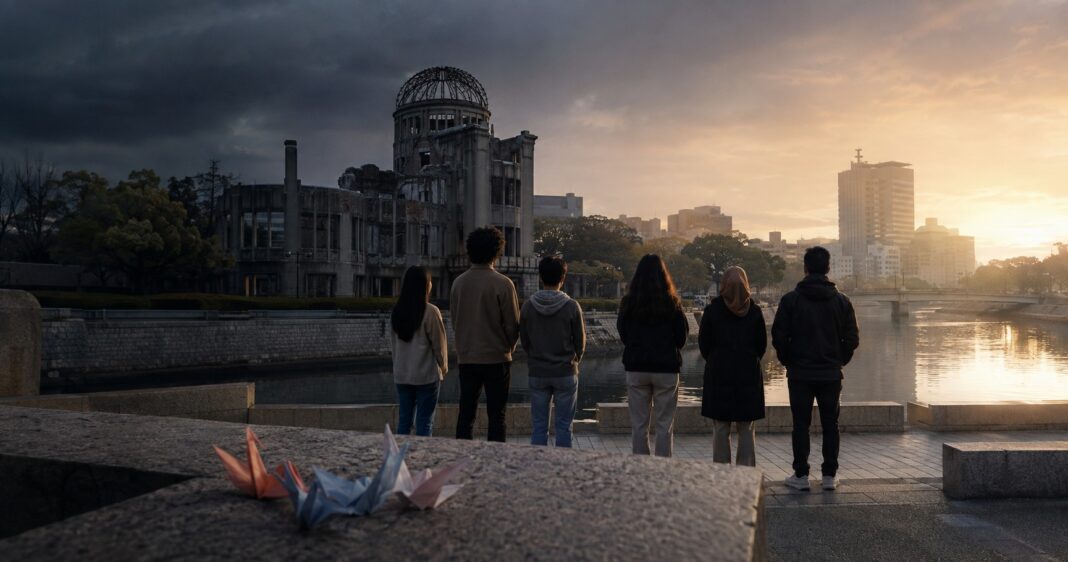

On the 81st anniversary of the atomic bombing, Hiroshima’s Peace Declaration and the U.N. secretary-general’s message set out two possible futures as the global nuclear order frays
By Katsuhiro Asagiri
Hiroshima (INPS Japan) – This year’s Hiroshima Peace Declaration did not begin with words of remembrance alone. It opened instead with what the declaration called “military invasions using nuclear weapons as tools of intimidation,” “imperious actions by major powers in violation of international law,” and the failure of the Nuclear Non-Proliferation Treaty, or NPT, Review Conference — for the third consecutive time — to adopt a final document.|JAPANESE|
The order was deliberate. The catastrophe of 81 years ago is not a memory sealed off in the past. It is directly connected to a present in which nuclear weapons are once again invoked as a means of projecting state power and coercing adversaries.
Hiroshima’s mayor, Kazumi Matsui, described a world in which distrust breeds retaliation, and retaliation is used to justify further violence. Such cycles, he warned, could ultimately result in “another Hiroshima or Nagasaki.”
At the same ceremony, Izumi Nakamitsu, the U.N. under-secretary-general and high representative for disarmament affairs, delivered a message from Secretary-General António Guterres that distilled the warning into a single question: What has humanity learned from Hiroshima? Will it choose a peaceful future, or continue to live under the shadow of nuclear annihilation?
This was not a rhetorical flourish reserved for a commemorative ceremony. What followed was an account of a world in which decades of nuclear arms reductions are being reversed, the norm against nuclear testing is under strain, military spending is surging and nuclear threats are increasingly used as instruments of intimidation.
One message spoke through the memories of survivors; the other through the crisis confronting the international system. But both arrived at the same place. Will the world continue to call an order sustained by fear “security”? Or will it restore dialogue, diplomacy, international law and trust — all of them slow and difficult — to the center of security policy?
From Personal Memory to a World in Crisis
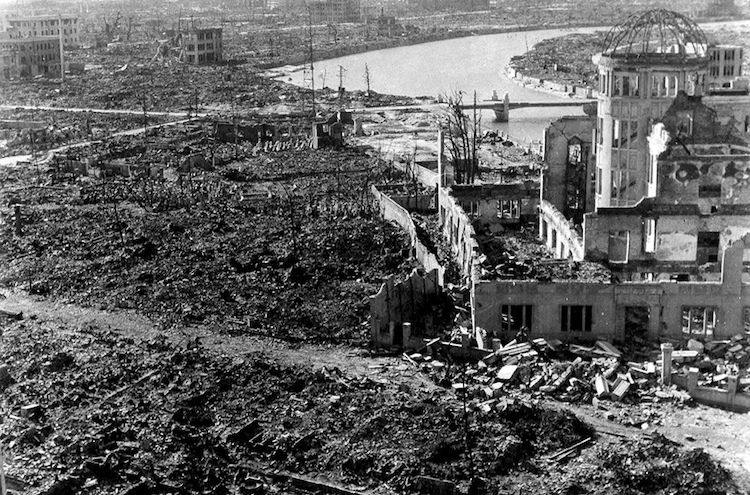
At the heart of the Peace Declaration was not nuclear strategy, but human experience.
It recalled a woman who could never forget her sister, whose skin had peeled away and whose face had been horribly disfigured by the bombing. It spoke of another woman who was exposed to the bomb at the age of 3, suffered repeated illnesses and lived in fear of what disease might strike next.
And there was a man who survived the bombing at 9. Watching civilians die in Russia’s invasion of Ukraine, he told young people that building a world without conflict must begin with overcoming the impulse toward conflict within themselves and making an effort to understand the perspectives of others.

Such testimony is a reminder that the damage caused by nuclear weapons does not end with the blast. Radiation-related illness, the loss of family, discrimination and anxiety about the future can shape a life for decades. When strategists calculate the value of possessing nuclear weapons, it is this long span of human time that most easily disappears from view.
Mr. Guterres’s message noted that as the number of hibakusha, the atomic bomb survivors, declines, the importance of their words only grows. Their testimony is more than a record of tragedy. It is evidence that brings the abstract concept of nuclear deterrence back to the reality of human bodies and human lives.
Mr. Matsui called on citizens and young people to build connections across national borders with those who hold different values. Mr. Guterres urged governments to choose dialogue over division and cooperation over confrontation. The proposals may appear to operate on different scales, but they share a premise: Distrust among nations deepens when societies lose the capacity to understand those they see as different.
The Nuclear “Bargain” Nations Can No Longer Agree On
To understand the present crisis, it is necessary to examine the bargain on which the NPT rests.
Non-nuclear-weapon states agree not to acquire nuclear arms. Nuclear-weapon states undertake to pursue nuclear disarmament in good faith. And all parties retain the right to the peaceful use of nuclear energy under international safeguards. The treaty bound these three commitments together as a single grand bargain.
The framework was never complete. India, Pakistan and Israel remain outside the treaty, while North Korea has declared its withdrawal. Nor have the nuclear-weapon states recognized by the treaty fully honored their longstanding commitment to disarm.

At the 2026 Review Conference, that imbalance collided with intensifying geopolitical conflict.
One dispute over the final document concerned language stating that Iran must not seek nuclear weapons. The United States and others pressed for stronger wording on Iran’s uranium enrichment and its cooperation with the International Atomic Energy Agency, or IAEA. Iran objected to being singled out and argued that attacks by the United States and Israel on its nuclear facilities had themselves damaged international law and the nonproliferation regime.
But Iran was not the sole cause of the breakdown. It was where a deeper fracture came to the surface.
In the war in Ukraine, the safety of nuclear-related sites, including the Zaporizhzhia Nuclear Power Plant, has repeatedly been placed at risk. In the Middle East, a zone free of nuclear weapons and other weapons of mass destruction, first promised in 1995, has still not been established. And under AUKUS, the security partnership among Australia, Britain and the United States, the planned transfer of nuclear-powered submarine technology to a non-nuclear-weapon state has raised questions about safeguards and the precedent it may set.
Meanwhile, China is expanding its nuclear forces, arms control between the United States and Russia is receding, and all nine nuclear-armed states are modernizing their arsenals. If nuclear powers and their allies place ever greater importance on deterrence while demanding restraint only from non-nuclear states, suspicion will inevitably grow that the treaty is less a mechanism for preventing proliferation than a system for preserving the privileges of those that already possess the bomb.
The NPT Review Conference has now failed to agree on a final document three times in succession — in 2015, 2022 and 2026. The last consensus was reached in 2010.
The treaty will not disappear tomorrow, and there is no alternative framework with anything close to its near-universal membership. But institutions do not always collapse overnight. Each time promises are deferred, criticism of violations is applied selectively and a conference ends without agreement, a little more faith is lost in the proposition that states are safer when they abide by the system.
As Ms. Nakamitsu observed after the Review Conference, nonproliferation and disarmament are two sides of the same coin. Nuclear-weapon states cannot indefinitely demand that others forgo nuclear arms while failing to meet their own obligations under Article VI of the NPT. The problem is not the wording of the treaty. It is whether governments still believe in the bargain it represents.
When Disarmament Goes Into Reverse
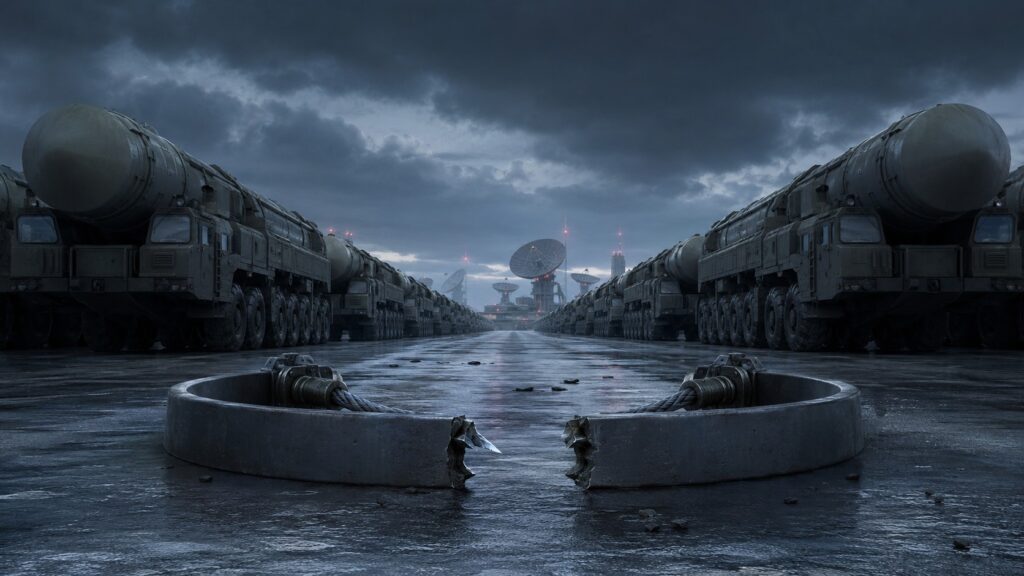
The signs of eroding trust extend far beyond the conference room.
The New Strategic Arms Reduction Treaty, or New START, which imposed verifiable limits on the strategic nuclear forces of the United States and Russia, expired on Feb. 5, 2026. For the first time in more than half a century, the strategic arsenals of the two countries that possess most of the world’s nuclear weapons are no longer subject to legally binding limits.
The norm against nuclear testing is also under pressure. In 2025, the U.S. president spoke of resuming “testing,” without making clear whether he meant nuclear explosive tests or missile trials. Against that backdrop, the United States became the only country to vote against a draft resolution in the U.N. General Assembly’s First Committee calling for the entry into force of the Comprehensive Nuclear-Test-Ban Treaty, or CTBT. Even if no explosive test takes place, ambiguity from a major power about its support for a longstanding norm can give other countries a pretext to weaken it in turn.
Military spending is climbing as well. According to the Stockholm International Peace Research Institute, or SIPRI, global military expenditure reached a record $2.887 trillion in 2025, marking an 11th consecutive annual increase in real terms. Spending rose by 14 percent in Europe and by 8.1 percent in Asia and Oceania.
Every government has an explanation: Russia’s invasion, China’s rise, uncertainty about alliance commitments, preparations for regional conflict. Considered separately, each can be understood as a response to a security concern. But one country’s defense appears to another as a threat. One side arms in response to the other, prompting the other to build up again. This is the security dilemma: Actions taken in the name of safety can make the system as a whole more dangerous.
Supporters of nuclear deterrence point to the fact that nuclear weapons have not been used in war since Hiroshima and Nagasaki as evidence that deterrence works. Yet there have also been numerous episodes in which false alarms, equipment failures, misread intelligence or errors of judgment brought the world dangerously close to nuclear war.
At a discussion held alongside the 2026 NPT Review Conference, the lesson was expressed in a stark phrase: “Luck is not a security strategy.” Nuclear deterrence requires every future leader, every intelligence assessment and every communications system to function correctly in every crisis. As artificial intelligence is incorporated into warning and command-and-control systems, faster decision-making could also leave less time to recognize and correct a mistake.
Whether nuclear deterrence played a role in the past and whether it can remain safe indefinitely are not the same question.
What the Ban Treaty Can Do — and What It Cannot
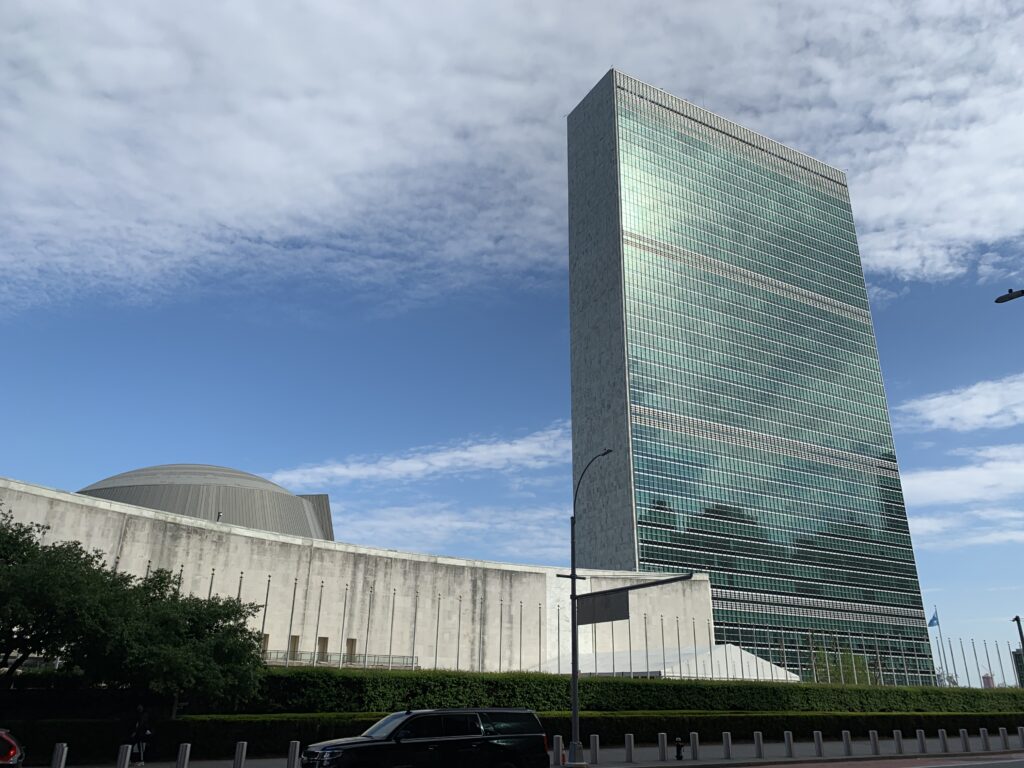
Against this backdrop, the first Review Conference of the Treaty on the Prohibition of Nuclear Weapons, or TPNW, will meet at United Nations headquarters in New York from Nov. 30 through Dec. 4. The conference will be presided over by South Africa, a country that once dismantled its own nuclear arsenal.
Tonga’s accession in July 2026 brought to 100 the number of countries that have signed, ratified or acceded to the treaty. Of these, 75 are states parties.
The TPNW comprehensively prohibits the development, testing, production, possession, use and threat of use of nuclear weapons. It also requires states parties to assist people harmed by nuclear weapons use and testing and to remediate contaminated environments.
That is where it differs from the NPT. While the NPT primarily manages the relationship between nuclear-weapon and non-nuclear-weapon states, the TPNW treats nuclear weapons themselves as a humanitarian issue and a matter of international law. It asks not who should be permitted to possess nuclear arms, but whether possessing them can be considered acceptable at all.
The Review Conference is expected to focus on a political declaration rejecting nuclear use and threats of use without exception; progress in carrying out the 2022 Vienna Action Plan; the work of the Scientific Advisory Group; mechanisms for victim assistance and environmental remediation; the designation of an international authority to verify the elimination of nuclear weapons; and the further universalization of the treaty.
Particular attention will fall on a proposed international trust fund for victim assistance and environmental remediation. The effects of nuclear weapons use and testing are still felt in Hiroshima and Nagasaki, at the Semipalatinsk test site in Kazakhstan, in the Marshall Islands and across other Pacific islands. If the fund takes shape, disarmament will no longer be only a negotiation over future numbers of nuclear warheads. It will also become a question of nuclear justice: Who bears responsibility for harm already done?
The TPNW has an obvious limitation. No nuclear-armed state has joined it, and the treaty alone cannot compel the elimination of nuclear warheads. Ignoring that fact would obscure the distance between establishing a prohibition and achieving actual disarmament.
But three consecutive failures at NPT Review Conferences have also shown that waiting for agreement among the nuclear powers will not produce progress on its own. The NPT can preserve the legal obligation to disarm, while the TPNW develops the norm of prohibition and practical approaches to victim assistance, environmental remediation and verification. The two treaties can be treated not as rivals, but as complementary frameworks, each addressing gaps left by the other.
Where Does Japan Stand?
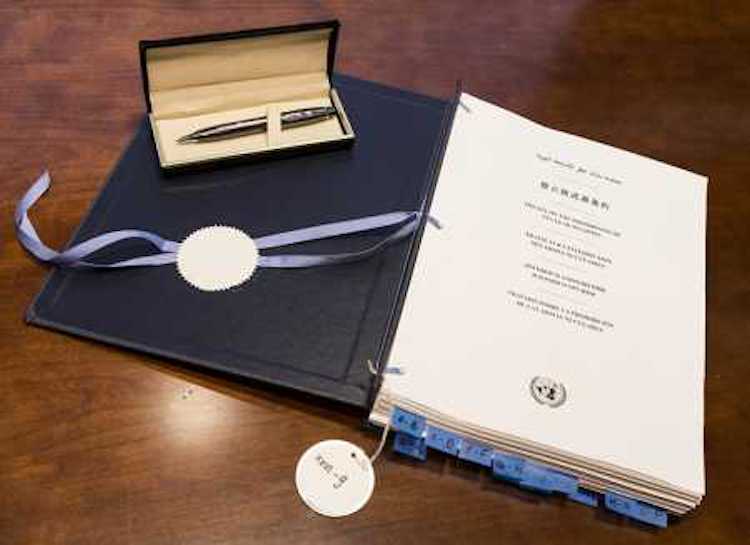
The Hiroshima Peace Declaration called on the Japanese government to begin by attending the TPNW Review Conference as an observer and then to ratify the treaty without delay.
Attending as an observer would not commit Japan to immediate accession. Some NATO countries that rely on the U.S. nuclear deterrent have attended previous meetings of states parties after explicitly setting out their differences with the treaty.
Japan’s participation would expose the tension between its reliance on nuclear deterrence and its identity as the only country to have suffered atomic bombings in war. But it would also allow Japan to draw on its extensive experience in medical care for survivors, research on the effects of radiation, preservation of testimony, victim assistance, environmental remediation and disarmament education to help build practical mechanisms.
For years, the Japanese government has described its role as a “bridge” between nuclear-weapon and non-nuclear-weapon states. But building a bridge requires listening, in the same room, to what each side fears and what each considers unjust. That claim loses credibility if Japan remains anchored to only one bank.
Rethinking What We Call “Reality”
Both messages called on citizens to act because nuclear policy is not shaped by governments and experts alone.
Through education, journalism, elections, culture, investment and everyday language, societies learn to regard nuclear weapons either as a guarantee of security or as an unacceptable humanitarian threat. That shared understanding, in turn, defines the range of policies a government believes it can pursue.
A future lived under the shadow of nuclear fear may not be chosen all at once by a single leader. It can also be chosen through an accumulation of small acts of acceptance: tolerating nuclear threats when they come from one’s own side, equating military expansion with security, and confining the testimony of atomic bomb survivors and nuclear test victims to commemorative anniversaries.
A world without nuclear weapons will not be achieved at a single conference, either. It will require people to learn what happened in the atomic bombings and nuclear tests; speak with those who hold different views; reject nuclear threats whether they come from an ally or an adversary; press governments to fulfill their disarmament obligations and attend the TPNW conference; and support victims and disarmament education. Each step may be modest. Each can also help change the standards by which society judges nuclear weapons.
What Hiroshima offered the world this year was not an optimistic prediction. It was a choice.
A future in which humanity continues to balance one nuclear terror against another — or a future in which nations build a common security that no longer requires nuclear weapons.
No one needs to be an expert to answer that question, and no one needs to wait for a government’s permission. Can security that depends on the threat of incinerating cities truly be called security? Asking ourselves that question is the first political act.

This article is brought to you by INPS Japan in collaboration with Soka Gakkai International in consultative status with UN ECOSOC.
INPS Japan