



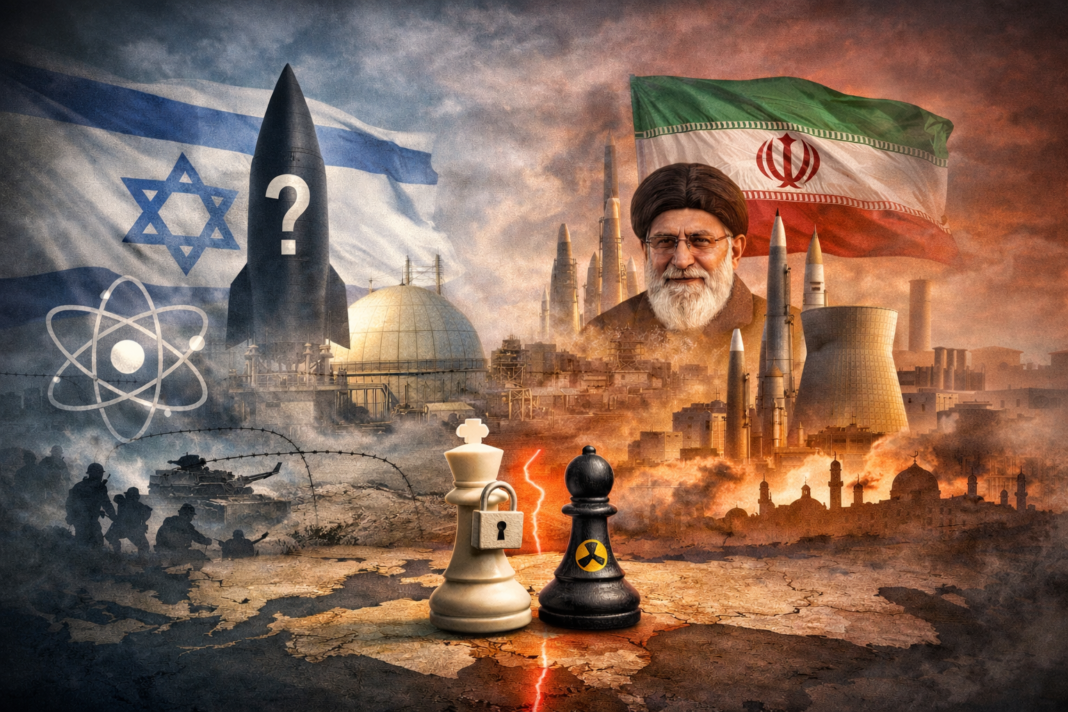

For more than six decades, Israel has maintained one of the most unusual nuclear postures in the world. While it is widely regarded by experts and intelligence agencies as a nuclear-armed state, Israel has never officially confirmed or denied possessing nuclear weapons.
By Roman Yanushevsky

Tel Aviv/Tokyo (INPS Japan) – For more than six decades, Israel has maintained one of the world’s most unusual nuclear postures. Although many experts and intelligence assessments regard Israel as a nuclear-armed state, it has never officially confirmed or denied possessing nuclear weapons.(P-30)|RUSSIAN|JAPANESE|
This deliberate silence—often called nuclear ambiguity, or amimut—has become a central pillar of Israel’s national security doctrine and a defining feature of the Middle East’s strategic landscape.
Silence Is the Strategy
Israel maintains nuclear opacity for several reasons. The first is quiet deterrence without open provocation. If potential adversaries believe an attack could bring catastrophic consequences, Israel can discourage war without issuing explicit threats or making public demonstrations.
Ambiguity also allows Israel to avoid the risks that come with openly declaring nuclear capability. The Middle East is highly volatile, arms-control mechanisms are weak, and rivalries run deep. By keeping its status unclear, Israel seeks to reduce the chances of nuclear brinkmanship—and to limit political pressure on other governments to “respond” by pursuing their own weapons. Uncertainty, in this sense, becomes a strategic tool.

A second reason is legal and diplomatic insulation. Israel has never signed the Nuclear Non-Proliferation Treaty (NPT). Because it does not openly declare a nuclear arsenal, it also avoids many of the inspection demands, sanctions risks, and legal constraints that might follow a formal acknowledgment.
Ambiguity has also helped Israel manage relations with Washington. Israel did not conduct an overt nuclear test, did not declare its status, and did not transfer nuclear technology to other states. Under those conditions, U.S. administrations have often found it easier to avoid a direct confrontation over the issue.
Finally, Israel’s security doctrine is shaped by history. The trauma of the Holocaust and repeated wars for survival have left a deep imprint. In that context, nuclear capability—if it exists—is widely understood in Israel as defensive and restrained, intended to prevent national catastrophe rather than to serve as an everyday instrument of warfare.
Israel and Iran: A Central Contrast
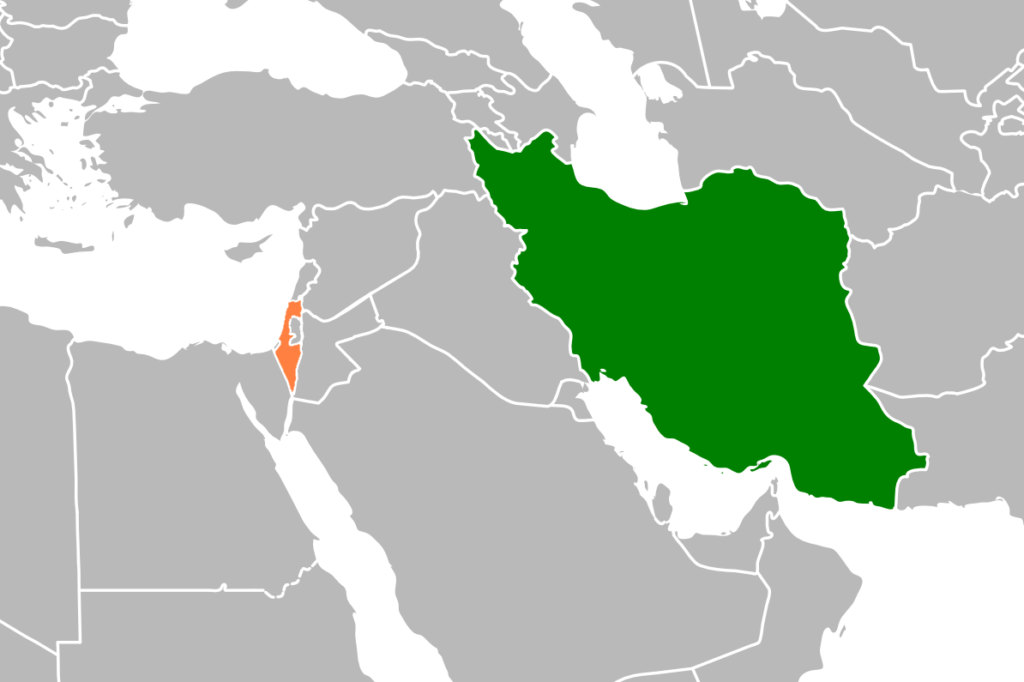
Israel’s most prominent regional adversary today is the Islamic Republic of Iran. Many Israeli officials and analysts argue that Iran has repeatedly threatened Israel’s existence and has pursued nuclear-related capabilities despite international constraints.
This creates a sharp contrast in Israel’s narrative: Israel presents its own nuclear posture (unacknowledged and framed as purely defensive) as fundamentally different from Iran’s ambitions, which Israel views as destabilizing and potentially existential.
The Origins of Israel’s Nuclear Program

Source: Wikimedia Commons
Israel’s pursuit of nuclear capability began soon after the country’s founding in 1948. Surrounded by hostile neighbors and shaped by the memory of the Holocaust, early Israeli leaders saw national survival as inseparable from strategic self-reliance. Prime Minister David Ben-Gurion, in particular, believed advanced scientific and military capabilities were essential to deter existential threats.
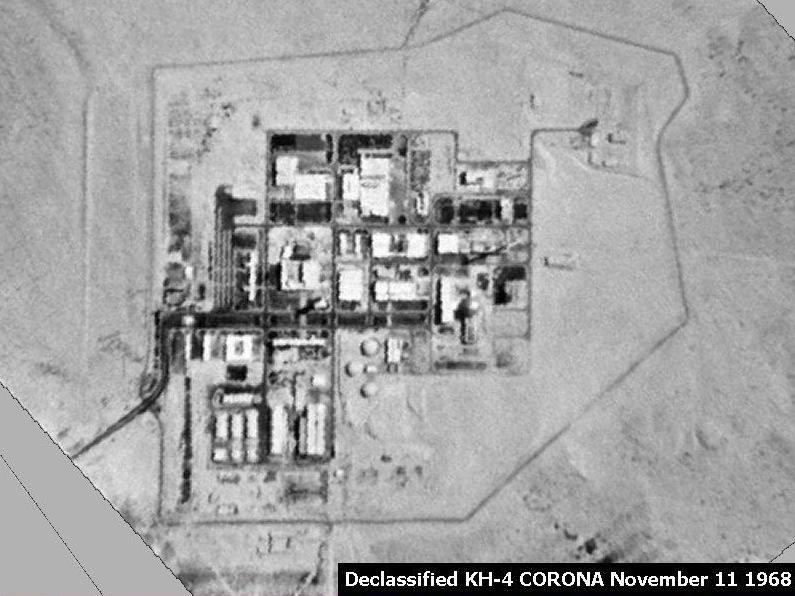
In the late 1950s, Israel began building a nuclear facility near Dimona in the Negev Desert. With substantial assistance from France, the site was presented publicly as a civilian research reactor. In practice, it was designed with infrastructure capable of producing plutonium—an essential material for nuclear weapons.
By the early 1960s, Western intelligence agencies had concluded that Dimona could support a military nuclear program. Yet Israel avoided an open clash with the United States. While Washington pressed for inspections and assurances, Israeli leaders managed disclosures carefully: limited visits were allowed, but strict secrecy was maintained around the facility’s most sensitive capabilities.
The Emergence of Nuclear Ambiguity
Rather than declaring itself a nuclear power, Israel chose a strategy of deliberate ambiguity. This was crystallized in the well-known phrase that Israel would “not be the first to introduce nuclear weapons into the Middle East.”
The wording was intentionally vague. It allowed Israel to signal deterrence without making a formal admission—leaving space to argue about what “introduce” means, and whether it refers to possession, testing, deployment, or public declaration.
This policy served several goals at once: deterring adversaries who assumed Israel had nuclear capability, avoiding diplomatic fallout that could follow an explicit declaration, and sidestepping international obligations—especially joining the NPT, which Israel has consistently declined to sign.
Secrecy and Controlled Disclosure

For decades, Israel’s nuclear program remained among the world’s most closely guarded secrets. The most significant breach occurred in 1986, when Mordechai Vanunu, a former technician at Dimona, provided detailed information to the British press. His disclosures suggested Israel had produced a significant number of nuclear weapons and had advanced technical capacity.
Vanunu was later abducted, tried, and imprisoned in Israel—an episode that underscored the state’s determination to preserve secrecy. Yet even after the revelations, Israel did not change its official stance.
Over time, Israel developed advanced missile systems and, according to widespread assessments, a second-strike capability linked to submarines. Still, Israeli leaders have largely avoided public discussion of nuclear weapons, maintaining ambiguity as a consistent policy line.
Implications for Regional Security
Israel’s nuclear ambiguity has had far-reaching consequences for the Middle East Deterrence and Stability
At its core, ambiguity has functioned as a deterrent. Many analysts argue that the widespread belief in Israel’s nuclear capability has discouraged large-scale conventional wars against it since the 1970s. By keeping adversaries uncertain about its exact capabilities and red lines, Israel aims to raise the cost of any existential attack—without openly escalating tensions.
Challenges to Non-Proliferation
Israel’s position outside the NPT remains controversial. Critics argue that an undeclared nuclear arsenal weakens global non-proliferation norms, especially in a region where other states face intense scrutiny. Supporters counter that Israel’s security environment is exceptional and that its long record of restraint distinguishes it from other proliferation cases.
Regional Arms Dynamics
Israel’s posture has shaped the calculations of other states. Several countries have cited Israel’s presumed arsenal as justification for pursuing nuclear-related programs in the past. Although many such efforts were halted, the perception of an uneven strategic balance continues to fuel mistrust and tension.
Iran and Contemporary Pressures
In recent decades, Israel’s ambiguity has taken on renewed importance amid ongoing concerns about Iran’s nuclear trajectory. Israel presents its own undeclared capability as a defensive necessity while strongly opposing any Iranian move toward nuclear weapons. This contrast complicates diplomacy and deepens polarization, since Israel’s deterrent exists outside formal international frameworks.
This article is brought to you by INPS Japan in collaboration with and Soka Gakkai International, in consultative status with UN ECOSOC.

INPS Japan