




By Katsuhiro Asagiri
ASTANA/Tokyo (INPS Japan) — The relationship between Japan and Kazakhstan is often described in terms of diplomacy, investment and regional cooperation. But at a time of growing geopolitical uncertainty, it deserves to be understood in broader terms: as a partnership linking cities, resources, technology and peace.
Kazakhstan’s capital, Astana, offers a powerful symbol of that evolving relationship. Built on the vast steppes of Central Asia, the city is often described as a futuristic capital, with glass-and-steel towers, broad boulevards and monumental architecture reflecting the aspirations of a young state seeking to define its place in the 21st century.
For Japan, however, Astana is not simply a distant capital. Its master plan was shaped in part by the late Kisho Kurokawa, one of Japan’s leading architects, who sought to combine Kazakhstan’s nomadic heritage, harsh natural environment and state-building ambitions with forward-looking urban design. That historical connection is now taking on new meaning as Japan and Kazakhstan expand cooperation in smart cities, green technologies, energy security and nuclear disarmament.
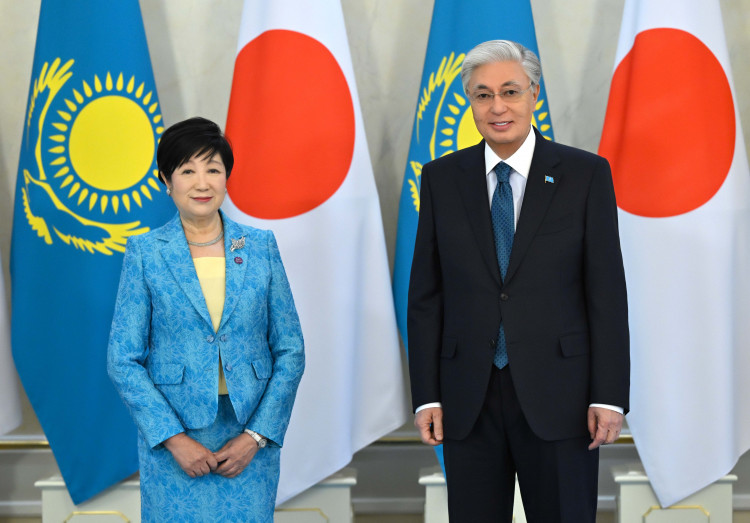
On May 22, Kazakhstan’s President Kassym-Jomart Tokayev met Tokyo Governor Yuriko Koike in Astana to discuss cooperation in smart city development, digital technologies, finance, education, emergency response and sustainable urban management. Tokyo, one of the world’s most densely populated metropolitan areas, has developed advanced systems in public safety, disaster preparedness, transportation and administrative services. For rapidly growing Astana, Tokyo’s experience provides a valuable reference point.
This is not merely technical cooperation. It points to a new form of urban diplomacy, in which cities work directly together to address shared challenges such as climate change, disaster risk, energy efficiency, digital governance and sustainable growth. In an age when many of the world’s most urgent problems are experienced first and most directly in cities, such cooperation matters.
Yet the deepening Japan-Kazakhstan relationship cannot be explained by urban cooperation alone. Behind it lies a more urgent geopolitical reality: instability in the Middle East and the resulting anxiety over energy security.
Japan has long depended heavily on the Middle East for crude oil. Tensions around Iran and the Strait of Hormuz pose risks that directly affect Japan’s economy and daily life. For Tokyo, diversifying energy sources, critical mineral supplies and transport routes is no longer simply a matter of trade policy. It has become a central element of economic security.
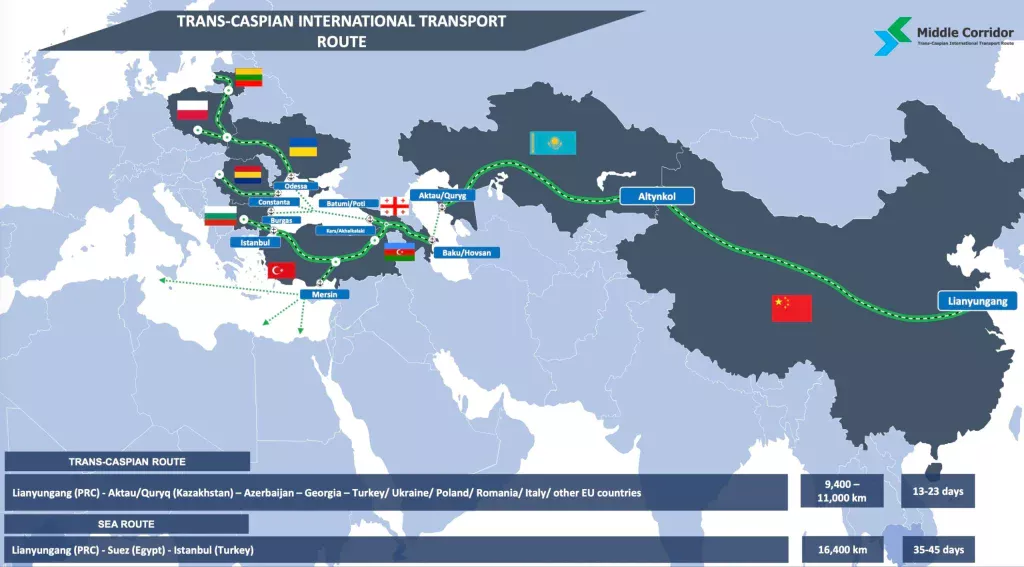
In this context, Kazakhstan has gained renewed importance. The country is rich in oil, natural gas, uranium and critical minerals, while also serving as a logistical hub linking Central Asia and Europe. At the “Central Asia plus Japan” summit held in Tokyo in December 2025, strengthening critical mineral supply chains and supporting the Trans-Caspian Corridor — a route connecting Central Asia and Europe without passing through Russia — were placed at the center of regional cooperation.
For Japan, rare earths, lithium and other critical minerals are essential to batteries, electronics, renewable energy systems and next-generation industries. Diversifying both sources of supply and transport routes is therefore an energy policy, an industrial policy and a security policy at once. Astana is increasingly becoming an important platform for Japan’s engagement with Central Asia.
The logic of this partnership is not limited to resources. It also extends to technology and sustainability. During Koike’s visit, a Kazakhstan-Japan business event brought together Japanese companies specializing in decarbonization, renewable energy, drone technologies and carbon credit solutions. On the Kazakh side, interest in Japanese expertise has been growing in renewable energy, artificial intelligence and digital transformation.
Urban development, environmental technologies, resource cooperation and logistics infrastructure are no longer separate policy fields. They are becoming part of a wider strategic framework in which Japan and Kazakhstan can complement each other: one with advanced technology and urban management experience, the other with resources, geography and a young capital still in the process of defining its future.
But there is a deeper layer to this relationship that should not be overlooked: the memory of nuclear suffering.

Japan is the only country to have suffered atomic bombings in war, in Hiroshima and Nagasaki. Kazakhstan endured severe radiation damage from repeated Soviet nuclear tests at the Semipalatinsk test site, where more than 450 nuclear tests were conducted between 1949 and 1989, leaving long-term consequences for local communities and public health.
In 1991, Kazakhstan closed the Semipalatinsk test site. After the collapse of the Soviet Union, it gave up one of the world’s largest nuclear arsenals remaining on its territory and chose the path of a non-nuclear-weapon state. That decision has become a defining feature of Kazakhstan’s foreign policy.
Japan and Kazakhstan both know, not as an abstract matter of security theory but through historical experience, what nuclear weapons can inflict on human beings, communities, the environment and future generations. This shared memory gives the bilateral relationship a distinct ethical foundation.
That memory has also shaped sustained cooperation among governments, civil society and international organizations. INPS Japan has reported on nuclear disarmament-related conferences and events involving Kazakhstan’s Ministry of Foreign Affairs, the International Committee of the Red Cross, the Center for International Security and Policy, the International Campaign to Abolish Nuclear Weapons and Soka Gakkai International.
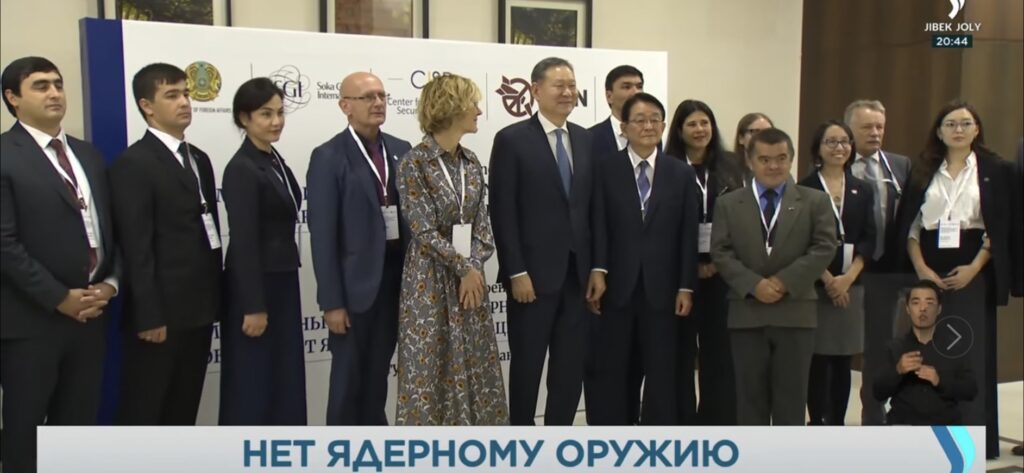
One notable example was the anti-nuclear exhibition “Everything You Treasure — For a World Free From Nuclear Weapons,” jointly organized in Astana by SGI, ICAN and Kazakhstan’s Center for International Security and Policy. Held in September 2022 at Keruen Mall in central Astana, the exhibition used photographs, illustrations and graphics to educate young people about the dangers of nuclear weapons, from the atomic bombing of Hiroshima to the continuing humanitarian consequences of nuclear arms.
Such initiatives are important because nuclear disarmament cannot be left to diplomats alone. If the memory of Hiroshima, Nagasaki and Semipalatinsk is to shape policy, it must also be passed to younger generations. Exhibitions, survivor testimony, documentaries and civil society campaigns help ensure that nuclear weapons are discussed not only as instruments of deterrence, but also as weapons with catastrophic human, environmental and intergenerational consequences.
In 2023, a regional conference in Astana addressed the humanitarian impact of nuclear weapons, the Central Asian Nuclear-Weapon-Free Zone, testimony from nuclear test victims, and victim assistance and environmental remediation under the Treaty on the Prohibition of Nuclear Weapons. Unlike debates that frame nuclear weapons mainly in terms of deterrence or national prestige, such forums place affected people, their families, communities and environment at the center.
A documentary on Kazakhstan’s nuclear test victims, I Want to Live On: The Untold Stories of the Polygon, produced by Kazakhstan’s CISP with support from SGI, has also helped bring the testimonies of second- and third-generation victims in the Semey region to international audiences. Together with workshops involving the United Nations Office for Disarmament Affairs and discussions on cooperation among nuclear-weapon-free zones, these efforts keep the humanitarian impact of nuclear weapons at the center of global disarmament debates.

In 2025, President Tokayev delivered a lecture at the United Nations University in Tokyo, warning that nuclear risks were again on the rise. Referring to Hiroshima, Nagasaki and Semipalatinsk, he stressed that Japan and Kazakhstan are both countries that understand the catastrophic consequences of nuclear weapons.
That message should be taken seriously. Japan and Kazakhstan do not occupy identical security positions. Japan continues to rely on the United States’ nuclear deterrence as part of its security policy, while Kazakhstan, having renounced nuclear weapons, is a member of the Central Asian Nuclear-Weapon-Free Zone. Yet both countries share common ground in seeking to transform the memory of nuclear harm into action for international peace.
This is why practical cooperation in smart cities, green technologies, energy transition, critical minerals and the Trans-Caspian Corridor carries meaning beyond ordinary transactions. It rests on a wider foundation: mutual trust, shared vulnerability and a common responsibility to help build a safer and more sustainable future.

At a time when crises in the Middle East are shaking the global energy order and nuclear risks are again moving to the forefront of international politics, the Japan-Kazakhstan relationship is no longer merely a story of friendship. It reflects Japan’s own choices in an age of uncertainty: whether to approach Central Asia only as a source of resources, or as a region with which it can build a broader partnership linking cities, technology, energy security and peace.
Astana, the futuristic capital shaped in part by a Japanese architect, has become more than a symbol of Kazakhstan’s ambitions. It is also a reminder that the future of international cooperation will depend not only on markets and infrastructure, but on memory, responsibility and the courage to imagine security beyond fear.
This article is brought to you by INPS Japan in collaboration with Soka Gakkai International in consultative status with UN ECOSOC.

INPS Japan