



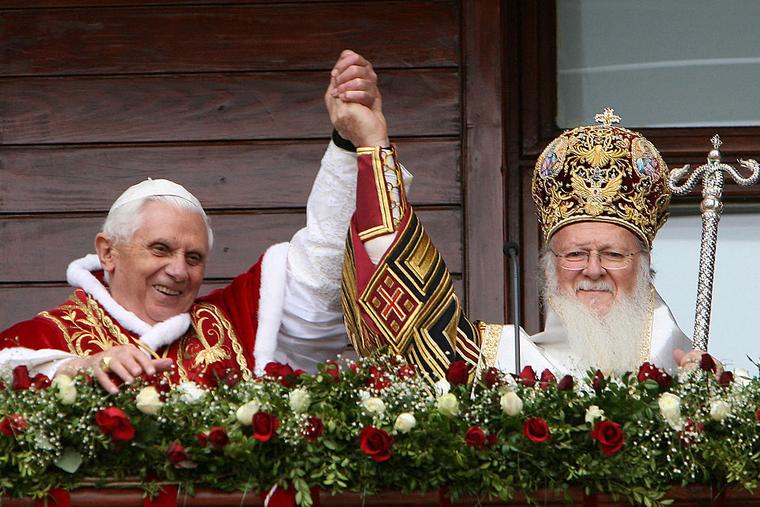

ANALYSIS: The third anniversary of Pope Benedict XVI’s death on Dec. 31 provides an opportunity to look at his little-acknowledged diplomatic acumen.
Victor Gaetan
The greatness of Pope Benedict XVI is indisputable. For good reason, he is widely acclaimed for his scholarship, humility and brilliant pastoral decisions, such as uplifting traditional forms of worship, thereby speaking to new generations of believers.
While pope, he published a bestselling trilogy on Jesus Christ’s life and ministry, Jesus of Nazareth, which universalized his reputation as an intellectual giant.
But Benedict is rarely credited with diplomatic accomplishments.
Restoring recognition to Benedict XVI for worldly achievements helps show continuity in the Vatican’s discreet international work. Three areas of special value include Benedict’s efforts in advancing Christian unity; strengthening ties with Shiite leaders in Iran; and improving bilateral relations with Vietnam and China.
Christian Unity
Under Pope Benedict’s leadership, meaningful gains were made in improving ecumenical relations, especially with the Greek Orthodox Church and the Russian Orthodox Church (ROC). In his eight-year reign, more was done to overcome historical ruptures with other Christians than ever before.
Three global trends made these relationships especially important: the marginalization of Christianity, especially in the West; increased violence against churches and believers, especially in the Middle East; and tension between Catholics and Orthodox in post-communist Russia.
In 2006, Benedict met with Ecumenical Patriarch Bartholomew I in Istanbul, Turkey, the historic seat of the Orthodox Church of Constantinople, now reduced to a few thousand believers. Together, the Pope (considered “first among equals” in global Orthodox leadership) and Pope prayed before relics of St. John Chrysostom and St. Gregory of Nazianzus, former bishops revered by both Churches.
While together, Benedict and Bartholomew signed a joint statement reviving a Catholic-Orthodox theological commission comprised of experts from both Churches, which had disbanded under Pope John Paul II. The two leaders maintained their ecumenical relationship over the years.The most significant development in deepening East-West Orthodox dialogue, though, was the election of a new Russian Orthodox leader, Metropolitan Kirill of Smolensk and Kaliningrad.
Rome and Moscow
The Russian Orthodox Church is the world’s largest Orthodox faith community. Relations between the Catholic Church and ROC – the latter being loyal to the Kremlin – reached a low in 2002 when Russia barred a Polish Catholic bishop from returning to Siberia, where he led the largest diocese in the world.
What repaired this brokenness was the ascension of Benedict XVI and the election of Patriarch Kirill in 2009. Kirill served as the ROC “foreign minister” for 20 years, so Benedict already knew him. The two men shared an analysis of the risks threatening the West. Having lived through totalitarian and authoritarian oppression, they saw rampant secularism as signaling a dangerous instability, inviting new forms of tyranny. They were also wary of radical Islam and its threat to minority Christian populations.
Cooperation began to flourish under Benedict and Kirill. The Vatican sponsored a “Day of Russian Culture and Spirituality” and the ROC organized a concert in Rome dedicated to Benedict. And Benedict established full diplomatic relations with Russia in 2009.
This newfound communication influenced relations between the Catholic Church in Poland and the Russian Orthodox Church. In 2012, on Benedict’s recommendation, the Roman Catholic bishops of Poland and the Russian Orthodox patriarch signed a joint message urging people of both nations to pursue reconciliation, premised on overcoming “mutual prejudice.”
In 2012, urged by Benedict, the Roman Catholic bishops of Poland and the Russian Orthodox patriarch (who spent four days in Poland) signed a joint statement, recognizing World War II’s horrors, urging people of both nations to pursue reconciliation, premised on overcoming “mutual prejudice.” The statement was inspired by the historic 1965 Polish German reconciliation exchange.
Pope Benedict promoted this pact because it demonstrates the relevance of Churches in modeling positive behavior. The Russian invasion of Ukraine (in February 2022) chilled relations between the Vatican and Moscow, but Pope Francis tried to avoid villainizing the ROC to protect progress made toward mutual respect since Pope John Paul II.
Benedict and Iran’s Shiite Leadership
Diplomatic relations between the Holy See and Iran have been ongoing since 1954.
On Dec. 27, 2006, Pope Benedict met privately with a high-level Iranian delegation, including Foreign Minister Manouchehr Mottaki, who handed the Pope a letter from President Mahmoud Ahmadinejad. The Vatican did not reveal the letter’s contents, but it likely related to the United Nations’ sanctions on Iran for “failure to halt uranium enrichment.” A U.S. State Department cable from Vatican City, revealed through Wikileaks, shows how closely the American government studied Vatican diplomacy on this matter.
As a theologian, Benedict was aware of a school of thought that sees Shiite Islam as closer to Christianity than Sunni Islam, especially in practice if not in dogma. Less than five months after Pope Benedict’s meeting with Mottaki, he met at the Vatican with a former Iranian president. Although the subject was ostensibly “dialogue between cultures,” Benedict also discussed nuclear power, saying the country had the right to develop this resource for peaceful purposes, as a source of energy. He noted that Iran practices religious freedom.
The doctrinal foundation that explains the open-hearted attitude toward Islam is grounded in the Second Vatican Council (during which the young Father Ratzinger had served as a theological advisor), when it was codified that the Catholic Church believes Christians and Muslims together “profess to hold the faith of Abraham, and together with us they adore the one, merciful God, mankind’s judge on the last day.” . The 1965 encyclical Nostra Aetate instructed the faithful to turn from past prejudice to see Islam in a new, positive way. Benedict’s approach facilitated events such as Catholic clerics and Shia scholars meeting in Iran’s holiest cities of Qom and Najaf in 2012 as part of ongoing dialogue.
The fact that Benedict prioritized relations with other faith communities, including the Shiites in Iran at a time when the country’s leadership was being castigated by Western governments, also laid the ground for Pope Francis, who gave special attention to religious leaders, especially in the Muslim world.
Vietnam and China
To an annual gathering in 2008 of diplomats accredited to the Holy See, Pope Benedict described diplomacy as “the art of hope.” It’s an attitude that helps explain the Church’s ability to pursue a diplomatic relationship for decades, despite seemingly slow progress.
Although Benedict never traveled to Asia (with the exception of the transcontinental nation of Turkey), he advanced breakthroughs in Vatican relations with Vietnam and China in particular.
In July 2005, an official delegation from Vietnam visited the Vatican, a week that included a Mass in St. Peter’s Basilica where Pope Benedict anointed 32 metropolitan archbishops, including Hanoi’s archbishop. Just four months later, the cardinal leading the Congregation for Evangelization of Peoples appeared in Hanoi, where he ordained 57 new priests.
Vietnam’s devout Catholic community of some 7 million people is the reason why no communist government was able to eliminate the faith.
In January 2007, Vietnam Prime Minister Nguyen Tan Dung led a delegation to Rome, where he met with the Pope, the first government leader to do so since the creation of the Socialist Republic of Vietnam. The Vatican described the meeting as a “new and important step.” The first visit of a Vietnamese president to the Vatican occurred ten months later.
The culmination of high-level meetings, in-country visits — between 1989 and 2011, the Holy See sent 17 delegations to visit Catholic parishes — and increased freedom for the Church in Vietnam was the appointment in January 2011 of a nonresident papal representative. Having an ambassador to a country (even one not living there full-time), helps the Vatican maintain ongoing communication with a government. Benedict laid the groundwork allowing for Francis’s appointment of a permanent apostolic envoy in Hanoi.
Reconciliation in China
Pope Benedict XVI did not signal any changes in Vatican diplomatic strategy regarding China, but he approved respectful gestures toward the government and the so-called “patriotic” church, including invitations to Rome.
In June 2006, a Vatican delegation embarked to Beijing for mid-level talks, attracting international media attention because it was the first public evidence in about five years that the Vatican and Beijing were negotiating. It was a tentative move, mainly to open a channel. Meanwhile, the government continued sponsoring Church infrastructure by opening the nation’s largest seminary.
In January 2007, the Vatican convened an internal summit, bringing top personnel from the Church in China, from cardinals down to missionaries, to Rome. At the assembly, participants were given a binder with a draft letter from Benedict to Chinese Catholics.
On the Solemnity of Pentecost, the Holy See released it publicly as the “Letter of Pope Benedict XVI, to the Bishops, Priests, Consecrated Persons, and Lay Faithful of the Catholic Church in the People’s Republic of China,” describing the goal for all believers as growing in unity.
It was the most important gesture toward China of Benedict XVI’s papacy, with both diplomatic and spiritual weight. The letter is a sophisticated document, written with great clarity, and animated by generosity, yet bluntly repudiating the “patriotic” church as “incompatible with Catholic doctrine” in a footnote.
A few months after the letter’s release came a sign of goodwill: Beijing’s archbishop died at an elite party hospital. Instead of promoting another party puppet to fill the high-profile post, the government named a parish priest with prior approval from Rome, Father Joseph Li Shan. A Beijing native from a longtime Catholic family, Father Li had never traveled abroad and was popular among the faithful for occasionally challenging the state-run patriotic Church.
Benedict’s letter to Chinese Catholics was a crucial marker for the overarching goal of unity for all Chinese Catholics, led by bishops selected by the Pope in consultation with the government.
Francis built on this progress within months of taking office.
Benedict’s diplomacy, though uncredited, showed its fruits in the next pontificate.
Original URL: Pope Benedict XVI: Unrecognized Global Greatness | National Catholic Register
INPS Japan